
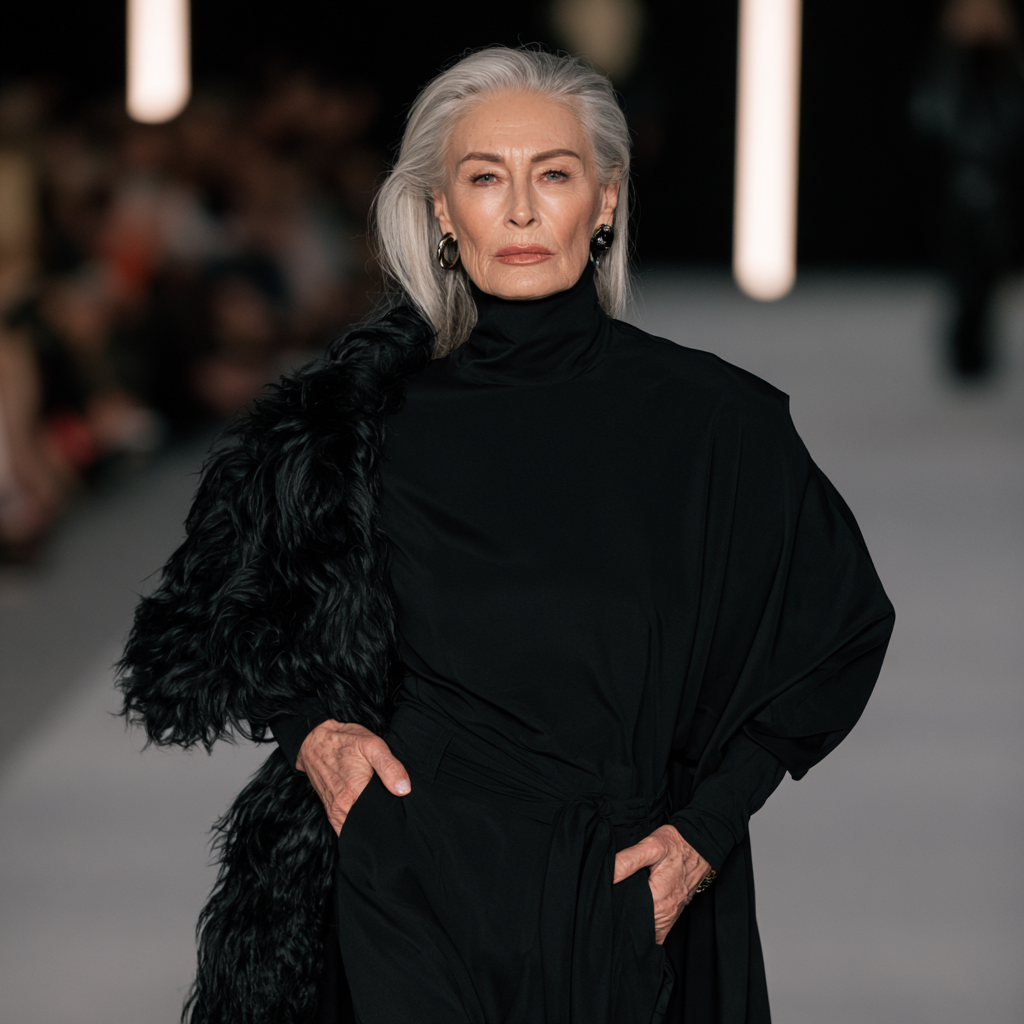
There is a version of this story we could tell as a heartwarming exception, a single casting choice worth a headline before fashion quietly returns to business as usual. We are not interested in telling it that way, because it undersells what we actually watched happen this year.
Consider the season in full. Miu Miu closed its show on Gillian Anderson, 57. Chloe Sevigny walked at 51. Kristen McMenamy, 61, appeared not as a nostalgic cameo but as a working model booked on merit. Christy Turlington closed Michael Kors. Kate Moss, 52, closed for Gucci. These were not retrospective tributes staged for applause. They were the closing looks, the positions fashion has always reserved for the moment a house wants to make its strongest statement.
We wanted to know why now, because an industry this image-conscious rarely moves on sentiment alone. Part of the answer, if we are honest, is economic rather than purely cultural. The women driving this shift also happen to represent the demographic with the deepest discretionary spending power in luxury retail, a fact the marketing side of the industry noticed considerably faster than the casting side ever did. Visibility, here, is not only a gesture of inclusion. It is also, quite plainly, a bet on who is actually buying the clothes.
That does not make the moment less real to us. It makes it feel more durable. A trend built purely on goodwill tends to reverse the moment the applause fades. A trend built on an industry’s own commercial self-interest tends to stay, because someone, somewhere, is watching the sales figures that justify it.
The cultural current runs alongside the commercial one rather than against it. Awards season told us a parallel story this year, with several of the most talked-about performances and wins coming from actresses well past the age at which the industry once quietly stopped writing them interesting parts. We keep noticing the same throughline connecting the runway and the screen. An industry that spent decades treating a woman’s fifth and sixth decades as a fade to background is suddenly finding those decades commercially, critically, and visually irresistible instead.
We are not going to pretend this erases the years the industry spent doing the opposite, and we would rather call this a beginning than a correction, because one strong season does not undo two decades of habit. But something has genuinely shifted in the casting room. The women who were told, quietly and for a long time, that the closing look belonged to someone younger are now the closing look themselves. To us, that is not a footnote to fashion’s story this year. It is closer to the headline the industry spent two decades avoiding.
Stay Unique, Darling.